Petrol Pump Line Gradient Icon: A Practical Asset for Modern Design Projects
In the world of digital and print design, the right visual language is crucial for clear communication. A well-crafted icon set can streamline workflows, enhance user interfaces, and present a professional image. The Petrol Pump Line Gradient Icon represents a specific asset within this landscape, offering a stylistic take on a common symbol. This article provides a practical evaluation of this icon, its characteristics, and its potential applications for various professionals.
Understanding the Core Asset
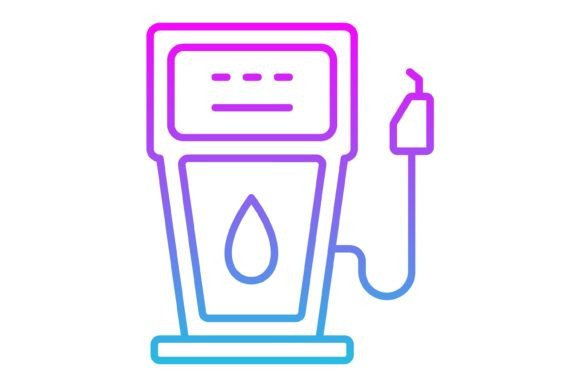
At its heart, this is a single, carefully designed vector icon depicting a petrol pump. The defining feature is its line gradient style. This means the icon is constructed using clean, linear strokes where the color transitions smoothly from one shade to another, creating a sense of depth and modern aesthetics. Unlike solid flat icons or complex illustrations, this approach aims for a balance between simplicity and visual interest.
The practical value of such an asset lies in its versatility. The Petrol Pump Line Gradient Icon is not just a static image; it's a vector-based design element. This distinction is fundamental. Vector graphics use mathematical paths rather than pixels, which means the icon can be scaled to any size—from a tiny favicon to a large banner—without losing clarity or becoming pixelated. This scalability is a non-negotiable requirement for any serious design work today.
Key Characteristics and File Flexibility
A significant strength of this offering is its delivery in five different file formats. This isn't a minor detail; it's a practical consideration that directly impacts usability across different software and platforms. The included formats—AI, EPS, JPG, PNG Transparent Background, and SVG—cover the vast majority of professional use cases.
- AI & EPS: These are the native vector formats for Adobe Illustrator and other professional vector editing software. They are essential for designers who need to customize colors, adjust stroke weights, or modify the gradient to fit a specific brand palette. The ability to edit the source file is where the true long-term value resides.
- SVG: The Scalable Vector Graphics format is the gold standard for web and mobile development. It's lightweight, resolution-independent, and can be manipulated with CSS and JavaScript. Using an SVG of the Petrol Pump Line Gradient Icon on a website ensures it looks crisp on any screen and can be styled dynamically.
- PNG with Transparent Background: This is the most universally compatible raster format for use in presentations, documents, and social media graphics where the icon needs to be placed over various backgrounds without a white box around it.
- JPG: A standard compressed format, useful for quick previews or contexts where file size is a priority and transparency isn't needed.
This multi-format approach demonstrates an understanding of real-world workflows. A web developer will reach for the SVG, a graphic designer for the AI file, and a content creator for the PNG. Having all options in a single package reduces friction and saves time.
Practical Applications and Audience Fit
Who would find a Petrol Pump Line Gradient Icon most useful? The applications are more specific than a generic "user" icon, but that specificity is its strength in the right context.
Mobile App and Web Developers working on applications for fuel delivery, ride-sharing, logistics, or travel planning would find this icon immediately relevant. It can serve as a clear, recognizable symbol for a fuel-related feature within a user interface. The gradient style can help it stand out without appearing overly cartoonish.
Marketing Professionals and Content Creators in the automotive, energy, or transportation sectors can use it in presentations, infographics, blog post headers, or social media content. It provides a professional visual shorthand for topics related to fuel, refueling, or fuel efficiency.
Educators and Publishers creating materials about the energy industry, environmental science, or automotive technology could incorporate this icon to illustrate concepts visually. Its clean design makes it suitable for educational contexts where clarity is paramount.
Small Business Owners in adjacent industries, such as auto repair shops, car rental agencies, or delivery services, might use it on their website or in print materials to visually reinforce their service offerings.
Evaluating Usability and Design Quality
The claim that the icon is "designed for maximum usability" is worth examining. A usable icon is one that is immediately recognizable, aesthetically consistent, and functionally clear. The line gradient style, when executed well, can enhance recognition by adding subtle depth that distinguishes it from a flat outline. However, the effectiveness of the gradient depends on its implementation. A well-balanced gradient guides the eye, while an overly complex one can cause visual noise at small sizes.
The set is described as containing 100 vector icons. This suggests the petrol pump is part of a larger, thematically consistent collection. For a professional, this is a major advantage. Using icons from the same set ensures visual harmony across a project. If you need a petrol pump, you likely also need icons for a car, a battery, a location pin, or a money symbol. A cohesive set saves the designer from the time-consuming and often fruitless task of matching styles from different sources.
The promise that icons are "ready to use for all devices and platforms" hinges on the provided file formats. The inclusion of SVG and PNG with transparency indeed supports this claim for digital use. For print, the vector AI and EPS files are the correct choice, ensuring high-resolution output.
Strengths and Considerations
The primary strengths are clear: vector scalability, multi-format delivery, and stylistic consistency (if part of a larger set). The "easy to edit" claim is valid for users with access to vector editing software. Changing the gradient colors in Illustrator is a straightforward process for a designer.
Potential limitations should also be considered. The line gradient style is inherently more decorative than a simple solid icon. In some minimalist UI contexts, a complex gradient might clash with a strict design system. Furthermore, the icon's effectiveness is tied to its cultural recognition; while a petrol pump is widely understood, the specific design must not deviate so far from the norm that it becomes ambiguous.
Another consideration is the source and licensing. Professionals must ensure the asset comes with a license that permits their intended use, whether for personal projects, client work, or commercial products. The article does not specify this, so due diligence is required before implementation.
Final Assessment
The Petrol Pump Line Gradient Icon, as described, appears to be a well-considered design resource. Its value is not in the single icon itself, but in its role as part of a flexible, multi-format system. For the right professional—someone in automotive tech, energy marketing, or logistics app development—it could be a practical timesaver that enhances visual communication.
The decision to use it should be based on a project's specific aesthetic requirements. If the goal is to add a touch of modern, dimensional clarity to a fuel-related interface or presentation, and the gradient style aligns with the overall design language, then this asset could be a worthy addition to a designer's toolkit. Its true test will be in its execution within a real project, where its scalability, editability, and visual impact will be fully realized.