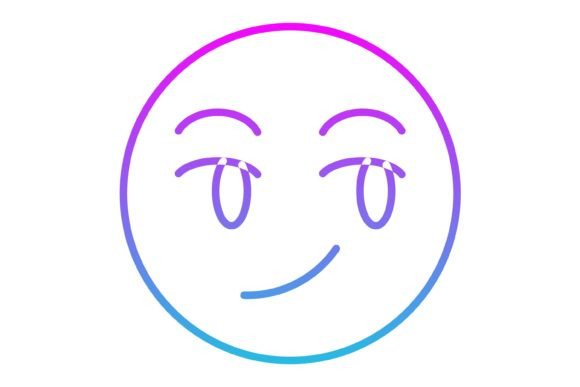
Understanding the Smirking Emoji Line Gradient Icon for Modern Design
In the expansive universe of digital assets, the selection of an icon set often comes down to a balance between aesthetic appeal and functional versatility. The Smirking Emoji Line Gradient Icon represents a specific approach to visual communication, blending the universally recognized "smirk" expression with contemporary design trends like line art and gradient fills. For designers and developers navigating the decision between flat, solid icons and more dynamic visual styles, this asset offers a distinct middle ground. It aims to convey a nuanced tone—playful yet confident—without relying on the heavy, cartoonish styles of older emoji sets.
Aesthetic and Functional Analysis
What distinguishes the Smirking Emoji Line Gradient Icon from standard pictograms is its visual depth. Traditional line icons rely on monochromatic strokes to maintain clarity, particularly at small sizes. However, the introduction of a gradient within the line work adds a layer of dimensionality that can make an interface feel more polished and modern. This style is particularly effective in contexts where the design language favors "glassmorphism" or soft, layered aesthetics, as the gradient can blend seamlessly into colorful backgrounds.
However, the trade-off with gradient-based icons is often legibility. While a solid black line icon offers maximum contrast, a gradient line icon relies on the transition between colors to define its shape. When evaluating this asset, it is crucial to consider the background color of the intended application. The inclusion of a transparent background in the provided formats is essential here, allowing the designer to test the icon against various surfaces to ensure the gradient does not wash out or clash with the underlying UI elements.
Format Versatility and Technical Specifications
A significant factor in evaluating any digital asset is the breadth of file formats provided. The Smirking Emoji Line Gradient Icon comes packaged in five distinct formats: AI, EPS, JPG, PNG, and SVG. This variety addresses the needs of different workflows, but understanding the specific utility of each helps in making an informed decision.
- Vector Formats (AI, EPS, SVG): These are critical for scalability. The SVG (Scalable Vector Graphics) format is particularly relevant for web and mobile development. Unlike raster images, SVGs can be scaled to any resolution without losing quality, and they often result in smaller file sizes, which improves page load times. The AI and EPS files are standard for print design and advanced editing in software like Adobe Illustrator.
- Raster Formats (JPG, PNG): The PNG format is the standard for digital use where transparency is required. Because the background is removed, the icon can be placed over complex textures or images without a white box surrounding it. The JPG format is typically used when file size is a priority and the background is a solid color, though it lacks transparency support.
For teams working across multiple platforms, this multi-format approach reduces friction. A developer can use the SVG for the mobile app interface, while a graphic designer uses the AI file to create a printed banner, ensuring that the visual identity remains consistent across the campaign.
Use Cases: Mobile, Web, and Print
The suitability of the Smirking Emoji Line Gradient Icon varies depending on the medium. In mobile app design, the icon's "line gradient" style fits well with modern operating system aesthetics that favor clean lines and subtle depth. It can be used effectively in chat interfaces, reaction buttons, or status indicators where a touch of personality is needed without overwhelming the user.
For websites, the SVG format allows for easy integration into CSS or HTML, enabling developers to change the color of the gradient via code to match the site’s theme dynamically. This adaptability is a strength over static image assets. However, for print applications, the gradient must be tested carefully. Gradients can sometimes reproduce unpredictably on different printing presses or paper types. The availability of the vector AI and EPS files mitigates this, as a print designer can adjust the gradient curve or convert it to a solid color if the print specifications require it.
In presentations, the icon serves as a visual aid to emphasize a point about strategy, success, or a "winning" concept. The smirk conveys a sense of insider knowledge or cleverness. However, in formal corporate presentations, the playfulness of the smirk might be perceived as too casual. In such cases, a more neutral or abstract icon might be a safer choice.
Comparison with Alternatives
When compared to solid flat icons, the Smirking Emoji Line Gradient Icon offers more visual interest but potentially less versatility in high-contrast environments (e.g., dark mode interfaces where gradients might be hard to see). Flat icons are generally easier to edit for color-blind accessibility.
When compared to 3D or fully rendered emoji, this asset is significantly lighter and more professional. Fully rendered emojis can look dated quickly as design trends shift, whereas line art tends to have a longer shelf life in professional UI design. The gradient adds a contemporary touch that keeps the icon from looking too basic, striking a balance between the minimalism of line icons and the richness of 3D assets.
Decision Factors for Implementation
Deciding whether to integrate the Smirking Emoji Line Gradient Icon into a project involves several practical considerations:
- Brand Tone: Does the brand voice allow for playfulness? The smirk implies humor and confidence. If the brand is strictly formal or deals with sensitive subjects, this icon may be inappropriate.
- Technical Environment: If the project requires heavy manipulation of icons (changing colors based on user themes), the SVG format is a major advantage. If the environment is older and does not support SVG rendering well, the PNG fallback is necessary.
- Scale of Usage: The asset is part of a set of 100 vector icons. If a project requires a consistent style across hundreds of different functions, one must evaluate if the other 99 icons in the set cover the necessary vocabulary (e.g., navigation, commerce, social).
Ultimately, the Smirking Emoji Line Gradient Icon is a specialized tool. It is best suited for projects that prioritize a modern, approachable aesthetic and require the technical benefits of vector scalability. For projects demanding absolute minimalism or extreme high-contrast accessibility, alternative solid-color sets might be more appropriate. By weighing these factors—visual style, technical format requirements, and brand alignment—designers can determine if this specific asset enhances the user experience or distracts from it.